Sell Circuit Breakers in Chicago, IL | Equipment Buyers
Transformer Buyers reviews circuit breaker opportunities from Chicago manufacturers, rail-freight operations, warehouses, high-rise facilities, and data centers case by case. Send accurate equipment and site records so the team can determine whether your surplus is a fit.
Transformer Buyers buys eligible surplus, used, and decommissioned circuit breakers from Chicago sellers, reviewing nationwide opportunities one lot at a time. Plant managers, electrical contractors, facility engineers, warehouse operators, property teams, and asset-recovery staff can submit equipment for consideration. Purchase interest depends on exact identification, condition, quantity, release authority, and practical access—not on a general ampere estimate. The company does not claim a Chicago-based crew, automatic pickup, or predetermined outcome.
Chicago’s industrial setting makes careful documentation valuable. The City’s industrial-corridor program supports manufacturing and other industrial uses while emphasizing freight infrastructure for industrial users [1]. Whether the lot came from a plant replacement, a warehouse consolidation, or a building modernization, keep each breaker associated with its inventory reference and its accessories.
02
What Circuit Breakers Can Be Submitted?
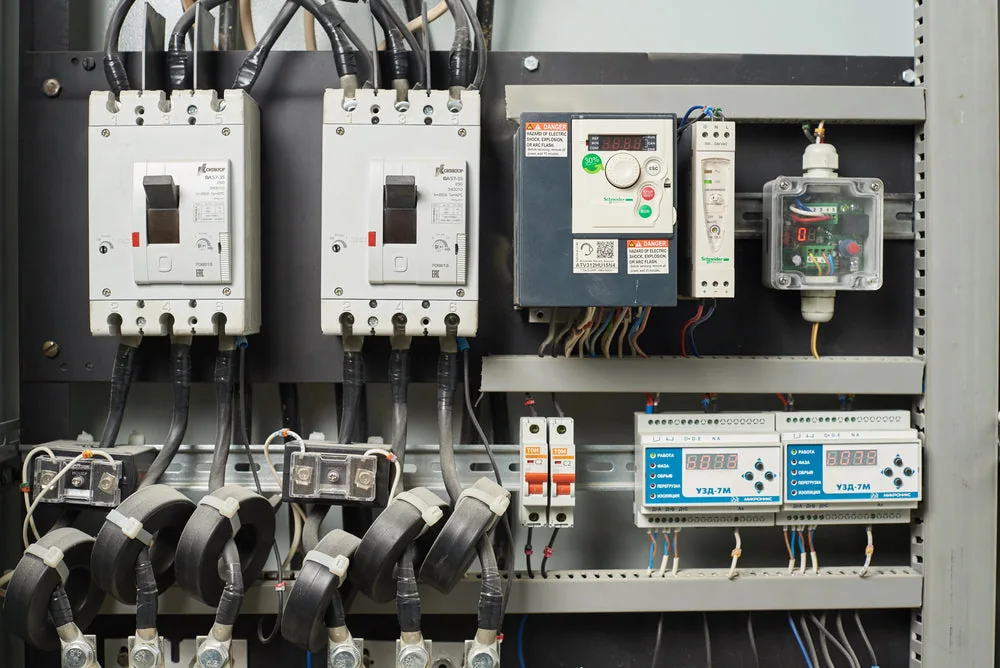
Submit identifiable molded-case, insulated-case, low-voltage power or air circuit breakers, panelboard breakers, switchboard breakers, and drawout units. The manufacturer and exact catalog number are central because similar-looking breakers can differ in capability, mounting, and resale usefulness. Describe equipment that remains in service as installed; do not call it loose, tested, or ready to ship unless records support that status.
Record the frame separately from the operating rating. On electronic-trip equipment, the frame can identify a construction maximum or product family, while the trip unit contains protection and metering settings [5]. Send the label information actually present, including sensor or rating-plug details where shown, rather than deriving a rating from the handle or a partial number.
For a high-rise, warehouse, or data-center upgrade, preserve related components as a set. Drawout cradles, shutters, secondary disconnects, communications modules, mounting bases, lugs, and interlock hardware may affect evaluation. Chicago identifies data-center growth as an infrastructure and policy issue [4]; that is a reason for controlled planning, not for disrupting operating equipment.
Molded-case units: show front, side, ratings, terminals, and mounting configuration.
Drawout or air breakers: show breaker, cradle, shutters, racking position, and accessories separately.
Panelboard or switchboard units: identify the lineup section and mounting style without opening energized gear.
03
Send Photos and Data That Identify the Lot
Start with legible current photographs and a line-item list. For each catalog number, send manufacturer, catalog or model number, frame, trip rating or long-time setting, poles, voltage, interrupting rating, trip unit, mounting or drawout details, quantity, and condition. Photograph the complete breaker, nameplate, side label, and included accessories. Only photograph terminals or internal areas when they are safely accessible after the facility has completed its own required clearance procedures.
Say whether each unit is installed, removed, boxed, palletized, or loose. Note missing parts, corrosion, water, smoke, heat, impact, contamination, fault history, modification, or unverified operation. Attach asset tags, purchase records, maintenance or test records, manuals, and decommissioning notes when available. One row per exact catalog number helps match every photo, accessory, and condition note to the right breaker.
04
Safety and Authority Come Before a Sale Inquiry
Never open energized equipment, remove a cover, pull a breaker, or expose live internal components to prepare a listing. OSHA identifies electricity as a serious workplace hazard with risks including shock, fires, explosions, and arc flash [3]. The owner’s qualified electrical personnel must control de-energization, lockout/tagout, authorization, removal, and safety procedures. A buyer’s review does not replace the seller’s safety program, electrical contractor, engineer, or authority having jurisdiction.
Before any release, confirm ownership and the person authorized to sell or remove the lot. Check leases, client commitments, utility requirements, building rules, and applicable environmental obligations. Maintain a chain-of-custody record linking serial numbers, photos, quantities, accessories, and release authorization. Do not describe equipment as tested, serviceable, code-compliant, or reusable without documentation that substantiates the claim.
05
Plan Freight and Site Access for Chicago Facilities
Chicago is a major intermodal freight center. CMAP reports that the region has extensive rail, truck, air, water, and industrial infrastructure, but also congestion and site-specific freight constraints [2]. For review, share the pickup city and ZIP code privately, loading-dock availability, forklift or pallet-jack access, approximate dimensions and weights if known, pallet condition, loading responsibility, and needed equipment. Do not assume that regional freight connectivity resolves a particular building’s access limitations.
Rail-related sites should identify rail access rules, escorted entry, rail-adjacent restrictions, and safe staging away from active operations. Warehouse sellers should distinguish ground-level dock removal from mezzanine, rack, roof, or restricted-area work. High-rise sellers should state the electrical-room floor, freight-elevator dimensions, door limits, dock reservation windows, security requirements, and whether an approved contractor must remove equipment. Data-center sellers should identify authorized change windows, escorts, access screening, redundancy constraints, and hardware-sanitization boundaries without sharing sensitive operational details.
Package removed units to protect terminals, mechanisms, and trip units. Keep matching accessories together and label every pallet to its inventory row. If the breaker is still installed, submit its documentation first. Transformer Buyers can assess the opportunity case by case; the seller should not commit to a loading or shipping arrangement until the applicable scope is agreed.
06
Prepare a Clear Chicago Surplus Submission
Send the contact role, inventory, photos, condition notes, release status, access constraints, and project timing. State whether the lot is spare stock, a renovation pull, a complete lineup, or a mixed inventory. Group identical items, but do not merge close-looking catalog numbers. Use the circuit breaker city directory for geographic context and the equipment guides for model-specific preparation; keep this Chicago inquiry tied to the actual available lot.
A factual package protects facility operations and lets Transformer Buyers decide whether further questions or a case-specific evaluation is appropriate.
Never open energized equipment or remove electrical equipment solely for an inquiry. Use qualified personnel, lockout/tagout procedures and applicable site rules.
Straight answers
Questions sellers ask.
These answers are intentionally specific and conditional. Final terms depend on the equipment and written agreement.
Can I submit breakers that are still installed in a Chicago facility?+
Yes, submit the installed lot for review and identify it accurately. The owner’s qualified personnel must control safety, authorization, de-energization, and removal. Do not open energized gear or remove equipment merely to create a listing.
Which circuit breaker details should I send first?+
Send manufacturer, catalog or model number, frame, trip rating, poles, voltage, interrupting rating, trip-unit details, mounting or drawout information, quantity, condition, and clear label photos. Include cradles and accessories where applicable.
Does a frame number establish the exact amp rating?+
Not necessarily. The frame may describe a construction maximum or family, while active amperage can depend on the trip unit, sensor, rating plug, or settings. Provide complete labels and trip information.
What should I disclose about used or damaged breakers?+
State whether units are removed, installed, stored, tested, untested, complete, or missing parts. Disclose water, heat, smoke, contamination, fault exposure, modifications, or physical damage, with close photographs where practical and safe.
What access details matter for a warehouse or high-rise lot?+
Provide dock, forklift, pallet, floor-level, elevator, door, loading-window, security, rigging, and loading-responsibility details. Rail and data-center sites may require escorts, approved schedules, or operating restrictions as well.
Does Transformer Buyers purchase every Chicago circuit breaker lot?+
No. Transformer Buyers reviews nationwide opportunities case by case. Interest depends on equipment identity, documentation, condition, quantity, authority to release, and practical site-access details. A complete inventory provides the best basis for review.