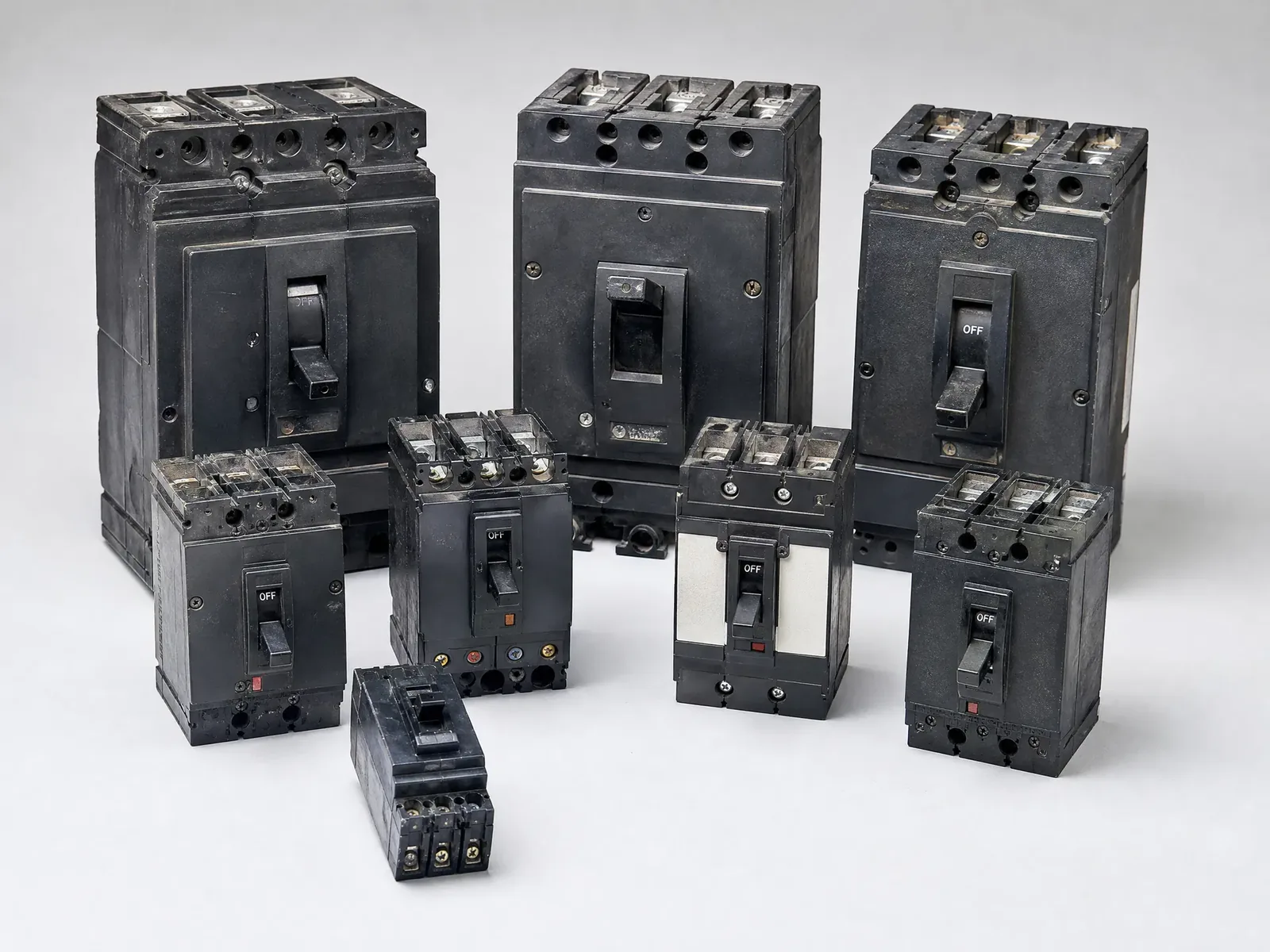
Transformer Buyers reviews nationwide opportunities to buy surplus insulated-case circuit breakers case by case. A legible nameplate, clear photos, trip-unit details, and honest site information help determine whether a complete breaker, drawout assembly, or documented lot is practical to evaluate.
01Frame size and trip rating are different fields.
02Drawout breakers may include a separate cassette.
03Interrupting rating must match its voltage basis.
04Only authorized personnel should isolate equipment.
01
Direct answer
Who buys insulated-case circuit breakers?
Transformer Buyers considers surplus insulated-case circuit breakers from plants, facilities, data centers, utilities, contractors, and electrical distributors nationwide. Each opportunity is reviewed case by case. Labeled breakers are easier to assess than unmarked parts, but a documented lot can also be submitted.
An insulated-case circuit breaker, or ICCB, is a molded-insulation breaker used in distribution equipment. It may combine a rated frame, electronic trip unit, operating mechanism, terminals, and optional controls. Eaton identifies communicating trip units, common accessories, and fixed or drawout configurations; these distinctions affect how a seller should describe a unit [1].
Complete fixed or drawout breakers with readable labels and undamaged cases.
Documented quantities of matching breakers, cassettes, trip units, or accessories.
Surplus from upgrades, shutdowns, spares reductions, or decommissioned distribution lineups.
02
What in an insulated-case breaker lot may be reviewable
A fixed breaker may retain lugs, rear connections, a motor operator, shunt trip, undervoltage release, auxiliary contacts, alarm switch, and interlocks. A drawout unit may include a cassette, cell hardware, racking interface, shutters, and secondary disconnects. Keep compatible parts together and photograph them as a set before separating them.
Condition and completeness matter. State whether the breaker was a shelf spare, removed from service, wet or dusty, damaged, or missing a trip unit. Do not describe an untested unit as operational. Schneider distinguishes unit-mount, rear-connection, and drawout arrangements, listing shunt trips, releases, switches, motor operators, and interlocks [2].
03
Identify the breaker before you submit it
Start with the manufacturer name, catalog or model number, and serial number from the breaker label. Photograph the front label, side labels, trip-unit face, and any rating plate without relying on a handwritten description. The frame rating is the breaker family’s maximum ampere capability; the trip rating or sensor setting describes the installed protection level. Record both exactly as marked. Do not infer one from the other.
Also capture the pole count, system voltage rating, and interrupting rating in kA RMS at the stated voltage. A number such as 65 kA means little by itself because published interrupting ratings vary with voltage. For example, Schneider’s catalog tables show distinct rating values at 240 Vac, 480Y/277 Vac, 480 Vac, and 600 Vac [2]. Note whether the trip unit is electronic, its make and model, and any settings visible from the exterior; do not remove covers or access live compartments to obtain information.
Manufacturer; catalog/model; serial number; and date code, when legible.
Frame rating, trip rating or sensor, poles, voltage, and interrupting rating with voltage basis.
Trip-unit model, ground-fault function, communications, and accessories visible on the unit.
Fixed, rear-connected, unit-mounted, plug-in, or drawout mounting; include cassette details if present.
04
Send photos and data that make a remote review possible
Send wide photographs showing each breaker’s overall condition and close photographs of every readable label. For a drawout design, include the breaker racked out only when facility procedure permits, the front and rear connections, the cradle or cassette identification, secondary contacts, and visible damage. For a fixed unit, show line and load terminals, mounting feet or rails, and installed accessories. A group photo with a count plus representative close-ups is more useful than one image of a large pallet.
In the accompanying list, state quantity by exact catalog number, whether units are identical, physical condition, test or service history if known, and whether any parts are missing. Include dimensions and approximate weight if they are known from records. Attach inventory sheets, purchase records, maintenance reports, one-line diagrams, and retirement or decommissioning documents when available. These records clarify configuration and chain of custody; they are not a substitute for a qualified inspection.
05
Keep isolation, authorization, and documentation ahead of removal
Do not open energized equipment, remove an energized breaker, or loosen terminals to get a better photo. The facility owner or employer should control access, switching, energy-isolation procedures, and authorization. OSHA’s lockout/tagout standard requires the employer to establish an energy-control program and requires verification of isolation before work begins [3]. Coordinate with the site’s qualified electrical personnel and follow the applicable written procedures, labels, and access controls.
Before a breaker leaves the site, retain a simple lot record: facility contact, owner authorization, equipment location, itemized count, condition notes, and photos tied to the items. Record whether the unit has been de-energized and released for removal, not merely switched off. If contractors are involved, align their procedures with the site’s process; OSHA specifically addresses communication between on-site and outside employers for covered servicing work [3].
Use the site’s authorized electrical and safety process before inspection or removal.
Preserve labels, tags, trip units, lugs, cassettes, and associated hardware with the correct item.
Identify any contamination, water exposure, missing barriers, or suspected damage before handling.
06
Plan freight and site access around the actual equipment
A breaker may fit on a pallet, while a drawout unit with its cassette or switchboard section requires a different plan. State whether the equipment is already loose, still installed, on a dock, in a secured electrical room, upstairs, or behind aisle and doorway restrictions. Share available loading equipment, dock height, forklift limits, crating needs, rigging rules, appointment requirements, and any site insurance or safety orientation requirements. These facts help determine whether the opportunity can be evaluated responsibly.
Protect the value of the information as well as the hardware. Do not ship a drawout breaker without securing loose accessories and identifying the matching cassette. Keep nameplate photos with the lot record, use packaging that prevents cracked housings or broken control components, and disclose any uncertainty about quantity or condition. For related equipment categories and geographic starting points, see the circuit-breaker buyer city directory at /circuit-breaker-buyers and the equipment guides listed below.
Never open energized equipment or remove electrical equipment solely for an inquiry. Use qualified personnel, lockout/tagout procedures and applicable site rules.
Straight answers
Questions sellers ask.
These answers are intentionally specific and conditional. Final terms depend on the equipment and written agreement.
Can I submit an insulated-case breaker if I only have the front label?+
Yes. Start with the clearest front-label and trip-unit photographs you have, then add side or rear labels when accessible under site rules. State what cannot be verified rather than guessing. A catalog number, frame, trip rating, poles, voltage, interrupting rating, and mounting style give a remote reviewer a useful starting point.
Is the amp rating on the trip unit the same as the frame rating?+
Not necessarily. The frame identifies the breaker family’s maximum ampere capability, while the installed trip unit or sensor establishes the protection rating or adjustment range. Submit both values exactly as marked. This distinction is especially important when similar-looking breakers carry different trip units.
Should I remove a drawout breaker from its cassette before asking for a review?+
Do not remove it solely to prepare a sale inquiry. Removal and racking should follow the facility’s authorized electrical and safety process. If the breaker is already safely released, photograph the breaker, cassette, secondary contacts, and identification labels together because the matched assembly may be more informative than separated pieces.
What if the breaker has a motor operator or electronic trip unit?+
Photograph and list each accessory instead of calling the breaker standard. A motor operator, shunt trip, undervoltage release, ground-fault function, communications module, auxiliary contacts, or interlock can affect configuration and completeness. Include any accessory catalog numbers and note whether items remain installed and intact.
Can I offer breakers removed from a damaged or wet electrical room?+
You can disclose the lot for review, but describe water, smoke, corrosion, impact damage, contamination, or missing components plainly and photograph the affected areas. Do not assume that a closed case protects internal components from every exposure. Condition information helps determine whether further evaluation is appropriate.
What site information should I provide before freight is discussed?+
Provide the city and facility type, whether the equipment is loose or installed, floor level, dock or ground-level access, approximate dimensions and weight if known, loading equipment, access restrictions, security procedures, and required documentation. Transformer Buyers reviews logistics and nationwide opportunities case by case; this information avoids planning from assumptions.