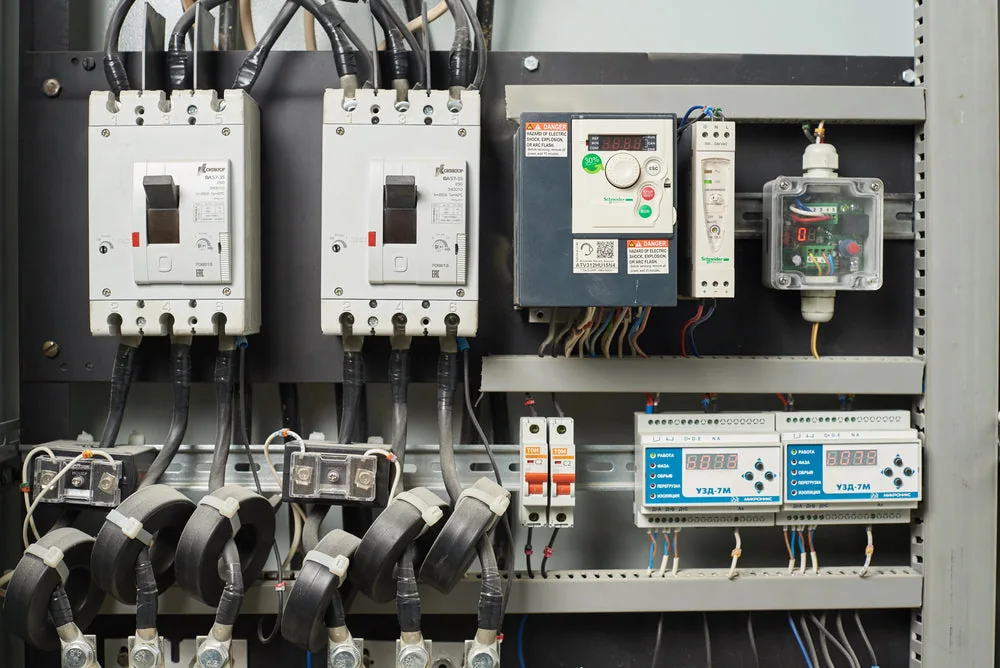
Transformer Buyers reviews surplus molded-case circuit breaker opportunities nationwide, case by case. Clear labels, honest condition notes, and practical removal details help determine whether an MCCB lot is suitable for resale or recovery review.
01Frame size and trip rating are different identifiers.
02Interrupting rating must include its stated voltage.
03Sharp catalog-label photos beat a typed guess.
04Authorized safe de-energization comes before removal.
01
Direct answer
Who buys molded-case circuit breakers?
Transformer Buyers evaluates offered molded-case circuit breakers (MCCBs) from industrial plants, commercial facilities, contractors, electrical distributors, data-center projects, and decommissioning inventories across the United States. Reviews are nationwide and case by case; not every individual breaker or lot will be a fit. Clear identity, usable condition, quantity, and documentation help a reviewer understand potential resale or recovery routes. Matching replacements, maintenance spares, retrofit work, and traceable lots may all have different demand.
An MCCB is an enclosed, resettable protective device used in low-voltage distribution equipment. It should not be identified by case shape alone. Manufacturers provide many frame sizes, connection methods, mounting styles, and trip technologies. Schneider Electric, for example, lists MCCB frames from 15 through 3000 A. A seller is not asked to certify that a breaker is suitable for a new installation; accurate identification and disclosure allow an informed review.
02
Identify the breaker from its markings
Begin with the manufacturer and the complete catalog, type, or model number on the front label, side label, or data plate. Photograph every readable marking. Record frame size and ampere trip rating separately: the frame identifies the product family and maximum physical rating range, while the trip rating identifies the installed protective rating or setting. A 400 A frame is not necessarily a 400 A trip breaker. If a label is worn, describe the uncertainty rather than reconstructing a number from memory.
Also record pole count, rated voltage, frequency where marked, and interrupting rating. Usually stated as AIC or kAIC, interrupting rating is short-circuit interrupting capability at a stated voltage; it is not the continuous ampere rating. Put the voltage alongside every interrupting-rating value and note AC, DC, or both. Identify the trip system as thermal-magnetic, magnetic-only, or electronic where the labels support it. For an electronic trip unit, photograph its face, rating plug, and visible settings without changing them.
03
Send photos and data that make the lot reviewable
A small, organized photo set is more useful than distant site photos. For an uninstalled, authorized-to-handle breaker, capture front, labels, sides, terminals, rear or mounting interface, accessories, packaging, and any defects. For installed equipment, let facility-qualified personnel decide what can be safely photographed. Do not open energized equipment, remove covers, reach past barriers, or loosen terminals for a better image. Preserve labels, seals, and settings.
Use one inventory line per catalog number. Distinguish exact matches from similar-looking items, and say whether quantities are counted, estimated, or still installed. Tie photos to a line item or pallet. If the nameplate is missing, provide clear exterior and mounting views so the uncertainty is visible.
Manufacturer, complete catalog/model or type number, and visible serial or date code.
Frame, trip rating, poles, voltage, frequency, and interrupting rating at its stated voltage.
Fixed, plug-in, I-Line, drawout, or other mounting details shown in photos, not assumed.
Quantity by catalog number, condition, history, and whether loose, boxed, palletized, or installed.
04
Describe condition and keep the records with the lot
Use factual condition descriptions: sealed new surplus, unused open box, removed from service, used spare, installed, incomplete, heat-affected, wet-exposed, or unknown. Photograph cracked cases, broken handles, missing barriers, corrosion, altered terminals, discoloration, contamination, label loss, or electrical-event evidence. Do not say a breaker is tested, calibrated, listed, or safe for reuse without records supporting that claim.
Retain available purchase orders, packing lists, panel schedules, equipment lists, maintenance or trip-test records, commissioning documents, and decommissioning scope. They can distinguish a mixed lot from exact matching inventory and show service context. Redact customer names, addresses, passwords, proprietary process details, and sensitive drawings before sharing. NEMA cautions that fire and heat exposure can affect molded-case breaker mechanisms through contaminants and foreign material, so disclose such exposure rather than drawing a fitness conclusion from photographs.
05
Make safe de-energization and authorization the first step
A sale inquiry does not authorize electrical work. The facility owner or responsible employer must determine who is authorized to isolate, lock or tag out, verify de-energization, and remove the equipment. OSHA identifies a manually operated circuit breaker as an energy-isolating device and requires an authorized employee to verify isolation and de-energization before covered work begins. An off handle, control button, or assumption that downstream equipment is dead is not a substitute for the site energy-control procedure.
Do not open energized panels, access live line-side conductors, defeat interlocks, alter trip settings, or perform an improvised test for a buyer. Follow the facility’s written procedures and applicable electrical-safety requirements. If documentation or removal would require energized work, describe the breaker as installed and route any next step through authorized electrical personnel. Safety, operational continuity, and site authority take priority over inventory speed.
06
Plan freight and site access around the actual inventory
Single MCCBs may ship in cartons; larger lots, accessories, enclosures, and removed gear may need pallets, shrink wrap, labels, and a documented piece count. Segregate catalog numbers, protect handles and terminals, and keep accessories with their matching unit. Do not infer shipping weight from amp rating: weigh completed pallets or state that dimensions and weights remain pending.
For bulk or installed lots, report the real location in the facility, floor level, staging route, dock or grade-level access, forklift availability, pallet-jack path, truck restrictions, security check-in, required insurance or safety orientation, loading hours, and outage constraints. State whether units are disconnected, still mounted, or mixed with other assets. Transformer Buyers considers access, freight, documentation, condition, and quantity during each nationwide review; no pickup, timing, or transaction outcome is assumed before evaluation. Explore the circuit-breaker equipment guide and city directory through the related resources below.
Never open energized equipment or remove electrical equipment solely for an inquiry. Use qualified personnel, lockout/tagout procedures and applicable site rules.
Straight answers
Questions sellers ask.
These answers are intentionally specific and conditional. Final terms depend on the equipment and written agreement.
Will you review one molded-case circuit breaker or only large lots?+
Transformer Buyers can review individual units and larger inventories nationwide, case by case. A single unit needs especially clear identification, ratings, condition, and photos because its relevance often depends on an exact match.
What is the difference between frame size and trip rating on my MCCB?+
Frame size identifies the breaker family and its maximum physical rating range. Trip rating identifies the installed protective rating or setting. Send both exactly as marked; they are not interchangeable.
Where do I find the interrupting rating?+
Look on the nameplate or catalog label for AIC or kAIC, often in a voltage table. Photograph the full table and report each value with its matching voltage. Do not substitute ampere trip rating for interrupting capacity.
Can I send photos while the breakers are installed?+
Yes, when exterior labels are accessible without entering a hazard area and site rules permit it. Do not open energized equipment or remove barriers. Authorized facility electrical personnel should direct isolation or removal.
Do used breakers need test records to be considered?+
Records help but may not be available. State whether maintenance, trip testing, commissioning, or service history is available, unavailable, or unknown. Do not claim testing or fitness for reuse without support.
What should I provide for a mixed pallet of MCCBs?+
List catalog number, quantity, ratings, condition, and matching photos for each group. Include pallet labels, packaging, accessory bags, damage, dimensions, actual weight when known, and loading constraints.