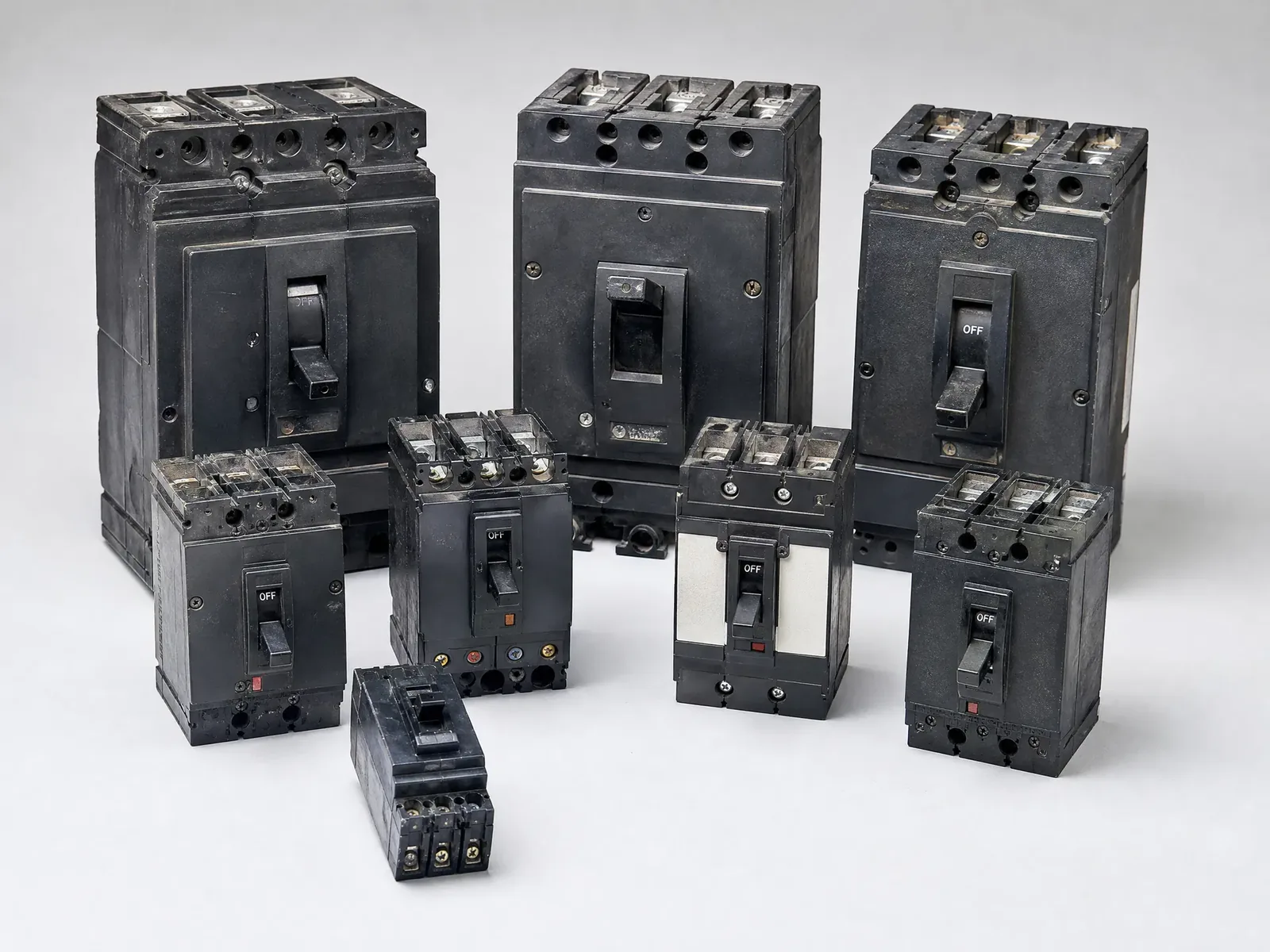
Transformer Buyers reviews identified current and legacy circuit breaker brands from sellers nationwide. A recognizable logo starts the conversation, but it does not establish model, condition, completeness, or acceptance; every opportunity is evaluated case by case.
01A brand mark alone is not enough to identify a breaker.
02Frame size and trip rating should be recorded separately.
03Nameplate photos are more useful than a typed brand guess.
04Only authorized personnel should isolate or remove equipment.
01
Direct answer
Who buys circuit breakers by brand?
Transformer Buyers reviews used and surplus circuit breakers bearing current and legacy manufacturer brands from facilities, contractors, distributors, and decommissioning inventories across the United States. We consider identifiable molded-case, insulated-case, power, air, and drawout breakers, plus related trip units, cradles, lugs, and accessories. Review is nationwide and case by case—not a commitment to buy every familiar brand.
What matters is the exact device and its sale context: catalog identity, electrical ratings, configuration, quantity, apparent condition, documentation, and realistic access. A logo can be useful evidence, but it cannot confirm that a unit is complete, compatible, unaltered, serviceable, or suitable for a particular buyer. Send what is actually marked and photographed; do not label a breaker as approved, tested, or interchangeable merely from its brand.
02
Recognize current and legacy names without guessing
Start with every name, trademark, and catalog marking visible on the breaker or its original carton. Sellers often encounter Square D, Eaton or Cutler-Hammer, Siemens, ITE, GE, ABB, Federal Pacific, Westinghouse, and other current or discontinued marks. The wordmark is a lead, not a final identification. Product ownership, families, and naming conventions change over decades, and separate product lines can share a corporate history without sharing mechanical or electrical fit.
Legacy equipment deserves careful transcription. ABB identifies ITE as a heritage brand with a history in low- and medium-voltage breakers [1]. That context can explain an ITE label in older gear, but it does not make every ITE-marked item eligible. Record the original brand exactly as shown, then capture the complete type or catalog number, serial or date code when visible, and all rating labels. Do not replace an older mark with a modern brand name unless manufacturer documentation supports it.
For a drawout breaker, photograph the breaker label and the cassette, cradle, or cell-interface label separately.
03
Identify the breaker beyond the brand
The nameplate converts a brand lead into a reviewable item. Record manufacturer, complete catalog/model or type number, frame designation, trip rating, poles, voltage, frequency if marked, and interrupting rating. Keep continuous ampere rating distinct from fault-interrupting capacity. UL notes that molded-case breakers with an interrupting rating other than 5,000 A are marked with that rating, and where several voltage/rating combinations apply, the values appear together [2]. Photograph the whole table so a reviewer can keep each kA or AIC value paired with its voltage.
Identify whether the breaker has a thermal-magnetic, magnetic-only, or electronic trip unit only when markings establish it. If the trip is interchangeable, capture its manufacturer mark, ampere rating, frame designation, rating plug, display, and visible settings without changing anything. UL's marking guide describes manufacturer, ampere, and frame markings for interchangeable trip units [2]. For a power or insulated-case breaker, note fixed versus drawout mounting, control voltage, secondary plug, and any included cradle or racking hardware.
Do not confuse a frame's maximum family range with the installed trip rating.
Count poles from an exterior view or label; never disturb conductors to verify them.
Describe accessories—shunt trip, undervoltage release, auxiliary contacts, lugs, or interlocks—as present or absent, not proven functional.
04
Send photos and data that make a brand review practical
Use one inventory line for each exact catalog number and link it to clear photos. Photograph loose, authorized-to-handle equipment on a stable surface; for installed equipment, capture only exterior information safely available under site rules. Manufacturer portfolios show why the detail matters: Schneider Electric lists molded-case breakers across broad frame ranges and multiple mounting or connection options, while power breakers can have separate electronic trip and drawout arrangements [3]. A sharp label and a complete configuration record are more useful than many distant facility photos.
Manufacturer; catalog/model or type; frame; trip rating; poles; voltage; and interrupting rating with its stated voltage.
Trip-unit make and type, rating plug, visible settings, accessories, terminals, covers, and included mounting or drawout details.
Front, label, side, rear, terminal, and mounting views, with close-ups of cracked cases, corrosion, heat marks, missing parts, or altered wiring.
Exact quantity by matching number, condition, whether installed or removed, packaging status, and available service, test, or maintenance records.
05
Put authorization, de-energization, and lot records first
Do not open energized equipment, remove covers, reach beyond barriers, loosen terminals, defeat interlocks, or operate a breaker merely to improve a listing. The facility owner or responsible employer must decide who is authorized and qualified to isolate, lock or tag out, verify absence of energy, and remove equipment. OSHA's hazardous-energy rule defines a manually operated circuit breaker as an energy-isolating device and requires an energy-control program for covered servicing work [4]. A handle position or a control button is not evidence that all hazards are controlled.
Preserve the paper trail with the lot. Helpful records include packing lists, purchase orders, one-line diagrams, panel schedules, equipment lists, commissioning files, maintenance or trip-test records, and decommissioning scope. State whether records are available, unavailable, or unknown; do not infer test status. Redact addresses, customer information, passwords, and sensitive operating details before sharing. Note water, smoke, heat, impact, contamination, missing labels, or modifications plainly, because honest condition disclosure lets the reviewer determine the appropriate next question.
06
Plan freight and connect the right equipment guide
Brand identification is only one part of an opportunity. For loose inventory, separate catalog numbers, protect handles and trip faces, label cartons or pallets, and provide piece counts, dimensions, and actual weights when available. For installed or bulk equipment, identify floor level, staging distance, dock or grade-level route, forklift availability, freight restrictions, security or safety requirements, loading hours, and outage constraints. Do not estimate a shipment's weight from amp rating or assume a pickup arrangement before the equipment and site have been reviewed.
Use the [circuit breaker city directory](/circuit-breaker-buyers-cities) for market context, then compare the [molded-case circuit breaker guide](/sell-molded-case-circuit-breakers) and [medium-voltage circuit breaker guide](/sell-medium-voltage-circuit-breakers). They support a clearer nationwide submission; Transformer Buyers still evaluates each lot, condition, documents, and access facts case by case.
Never open energized equipment or remove electrical equipment solely for an inquiry. Use qualified personnel, lockout/tagout procedures and applicable site rules.
Straight answers
Questions sellers ask.
These answers are intentionally specific and conditional. Final terms depend on the equipment and written agreement.
Does seeing a well-known breaker logo mean you will buy it?+
No. A logo begins identification, but Transformer Buyers reviews each opportunity case by case. Catalog number, ratings, configuration, quantity, condition, records, and freight or access facts determine whether a lot merits further discussion.
Can you review an ITE or another discontinued-brand breaker?+
Yes, legacy equipment can be submitted for review when it is accurately identified, but a discontinued mark is not an acceptance promise. Photograph the original label, catalog or type number, ratings, mounting arrangement, condition, and any associated switchgear or cradle information.
What information distinguishes two breakers from the same brand?+
Provide the complete model or catalog number, frame, trip rating, poles, voltage, interrupting rating, trip-unit details, and mounting style. Similar-looking cases may differ in fault rating, terminals, electronics, accessories, or drawout interface, so brand and ampere rating alone are insufficient.
Should I send a serial number or date code if it is visible?+
Yes. Include any visible serial number, date code, order information, or factory label without removing it. These details can help separate otherwise similar units and connect a breaker to its paperwork, but do not scrape labels or open equipment to find them.
May I photograph a breaker while it is still installed?+
Only when exterior markings can be photographed safely and in accordance with facility rules. Do not open energized equipment or remove barriers for photos. The facility's authorized electrical personnel should control any isolation, verification, or removal activity.
How should I list a mixed pallet of brands and models?+
Make a line-item inventory grouped by exact catalog number, with quantity, ratings, condition, and matching photos for each group. Show pallet labels, packaging, accessory bags, damage, dimensions, weight when known, and the actual loading or site-access constraints.