01
Direct answer
We Buy New and Used Electrical Switchgear
To identify your gear for a sale inquiry, begin with the manufacturer's assembly designation, serial or order number, and any construction standard shown in existing records. Report the wording exactly. If the documents say only metal-enclosed, do not upgrade that description to metal-clad based on appearance. You can submit an inquiry while the classification remains unconfirmed.
We review new and used electrical switchgear opportunities case by case. Construction type helps describe the assembly, but does not establish acceptance or an offer by itself. Include what is known about its configuration and condition, and clearly mark anything that still needs confirmation.
02
What metal-clad documentation tells you
For the medium-voltage equipment discussed here, metal-clad is a specific construction description. Eaton explains that equipment conforming to IEEE C37.20.2 has primary conductors insulated for the assembly's rated maximum voltage, with major primary circuit components separated by grounded metal barriers. Its VacClad-W design uses drawout vacuum circuit breakers. These are documented construction features, not details a seller needs to expose for photographs. [1]
Look for an explicit metal-clad designation or a C37.20.2 reference in an assembly manual, approved submittal or manufacturer drawing tied to your equipment. A document describing separate breaker, bus and cable compartments can support identification when its equipment number matches. A generic brochure for a similar-looking cabinet is weaker evidence than records for your actual assembly.
03
What metal-enclosed does not prove
Metal-enclosed wording alone does not prove the more specific metal-clad classification. Nor should all metal-enclosed gear be described as having one identical arrangement. Eaton's MVS provides a useful identification example: the manufacturer describes an integrated assembly of switches, bus and fuses and references IEEE C37.20.3. Available configurations include fused and non-fused switches, with manual or motor operation. [2]
MVS documentation distinguishes load-current interruption by the switch from short-circuit interruption by fuses when fitted. Do not describe a load-interrupter switch as a fault-interrupting circuit breaker. Also, the MVS design includes a grounded safety barrier, so a mention of a barrier alone is insufficient evidence of metal-clad construction. Copy the actual product designation rather than substituting a broader sales term. [2]
04
Match assembly labels to the right records
An assembly nameplate identifies the switchgear as a system. A circuit-breaker, relay or switch label identifies a component. Send both when those labels are already documented or externally readable, but explain which is which. A breaker model name alone should not be used to classify the entire enclosure.
Useful matching records include the manufacturer order number, drawing title block, serial number and section identifiers. Preserve the complete rating descriptions and units. Continuous current, voltage, short-time withstand and interrupting ratings describe different capabilities; a bus withstand rating is not automatically a breaker interrupting rating. Eaton separately documents assembly and breaker ratings, illustrating why a purchasing inquiry should retain those distinctions rather than presenting every kA figure as the same rating. [1]
05
Manufacturer names that help identification
Eaton identifies VacClad-W as metal-clad switchgear with Type VCP-W vacuum circuit breakers. Its documented arrangements include breaker-over-breaker and auxiliaries-over-breaker. Eaton MVS, by contrast, is its metal-enclosed load-interrupter switchgear example. If those names appear in your matching records, report the assembly family and the installed device designation separately. [1] [2]
Schneider Electric identifies Masterclad as air-insulated metal-clad switchgear with drawout vacuum circuit breakers, including Type VR breakers. Its published configurations include indoor and outdoor enclosures and one- or two-high breaker arrangements. A matching Masterclad designation is more informative than a description such as Square D metal cabinet. [3]
These examples are identification references, not a guaranteed purchase list, stock inventory or statement of an OEM relationship. They do not establish parts interchangeability. The exact assembly, documented configuration and available components still require individual review.
06
Exterior photographs that support classification
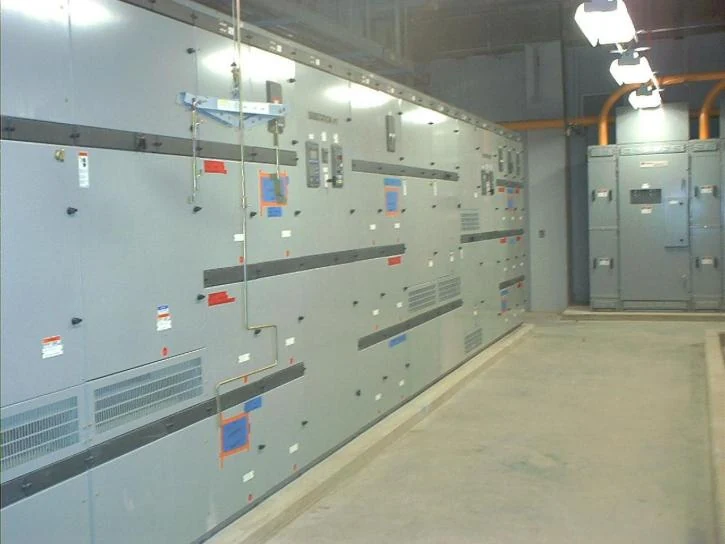
Where site rules permit safe photography, provide a full front view showing the section arrangement and a readable image of an existing exterior assembly label. Keep section numbers visible so the label can be associated with the correct portion of the gear. A separate exterior view can show whether an outdoor enclosure surrounds the equipment.
Door layout, visible handles, meters and exterior device labels can help connect the photographs to drawings, but cannot confirm hidden barriers or insulation. Do not operate handles, open compartments or remove covers to improve an inquiry. Use archived inspection photographs or manufacturer records instead. Explain when an image is historical, and note whether the assembly has changed since that photograph was taken.
07
Resolve conflicting descriptions without guessing
If a project schedule says metal-clad but the available assembly records say something else, send both and identify the discrepancy. Record any known replacement devices, modified doors or missing labels. Describe an undocumented classification as unconfirmed rather than treating a project nickname as the manufacturer's designation.
Do not infer arc-resistant construction from metal-clad wording. Eaton notes that standard metal-clad design testing does not include internal arcing faults, while arc-resistant enclosure options are available. Schneider likewise lists arc-resistant structures as an available Masterclad configuration. Supply the specific supporting records if your assembly is described as arc-resistant; the family name alone does not establish that option. [1] [3]
08
Send a construction-focused purchasing inquiry
Text available pictures to (951) 733-6603 or email electricalsurplusbuyers@gmail.com. Include the assembly manufacturer, exact family designation, location and whether the gear is new, used or of uncertain service history. Attach the matching nameplate record and construction drawing if available. State whether metal-clad or metal-enclosed is confirmed by records, or simply your current understanding.
A documentation inquiry is not an electrical inspection. OSHA requires specific safeguards for electrical work; equipment described as deenergized is not automatically safe to approach internally. Qualified personnel handle any necessary isolation, access and removal under applicable procedures. Do not perform tests or manipulate equipment for this inquiry. Purchase acceptance and any transaction arrangements remain subject to case-by-case review. [4]