01
Direct answer
Can you sell GE-labeled switchgear?
Yes, you can submit GE-labeled electrical switchgear for a purchasing inquiry. We buy new and used electrical switchgear, but the brand alone does not establish acceptance. Identify whether you are offering an assembled lineup, a separated portion of that lineup or equipment whose identity is still uncertain. Include the location and whether it remains installed.
The GE families described here are identification references, not a guaranteed purchase list, available stock or a parts-interchangeability claim. This page does not imply an OEM relationship. A useful submission describes what you own and what documentation supports that description; an offer, if available, depends on review of that particular equipment.
02
Separate the GE assembly identity from component names
Look first in existing photographs and records for the lineup designation, manufacturer, assembly serial or order number, and drawing references. Record the wording exactly, including suffixes. A GE breaker, meter or relay inside equipment does not by itself identify the manufacturer or family of the complete assembly. Likewise, a catalog number on a component is not an assembly serial number.
Keep assembly information separate from breaker information in your inquiry. If a plate is unreadable or unavailable, say so and provide the best existing front-view drawing or equipment schedule. Do not rename a switchboard as switchgear merely because it carries a GE logo. Preserve the classification stated in the assembly records and flag any conflict between the paperwork and exterior labels.
03
Use AK and AKR names to narrow legacy AKD identification
ABB's GE legacy reference associates AK low-voltage power circuit breakers with AKD-5 and earlier GE low-voltage switchgear. It identifies AK as the predecessor of AKR and associates AKR breakers with AKD-6 and AKD-8 switchgear, as well as other manufacturers' applications. These associations help organize your records; they are not enough to identify an assembly from one breaker photograph. [1]
For gear described as AKD-5, AKD-6 or AKD-8, submit the documented assembly designation alongside the breaker types actually included. ABB describes AK and AKR breaker families as obsolete, but that status does not establish the condition or purchase potential of your lineup. If records show replacement breakers or trip-unit upgrades, include those records rather than assuming the original configuration remains intact. [1]
04
Describe documented AKD-8 grounding equipment separately
Some AKD-8 documentation concerns a specific auxiliary system rather than the entire switchgear lineup. GE legacy instruction GEI-72116 describes a high-resistance pulsing ground-detection system supplied with AKD-8 switchgear, including grounding resistors, alarm indications and related control equipment. That document is not evidence that every AKD-8 assembly has this arrangement. [2]
If your existing drawings identify this system, mention whether its associated equipment is included in the proposed sale. Attach the relevant elementary diagram and note any documented missing items. This helps prevent a separate grounding cabinet or alarm package from being omitted from the description. Do not operate controls, trace faults or perform the manual's procedures to prepare an inquiry; the existing records are the useful starting point.
05
Identify Power/Vac as a different assembly configuration
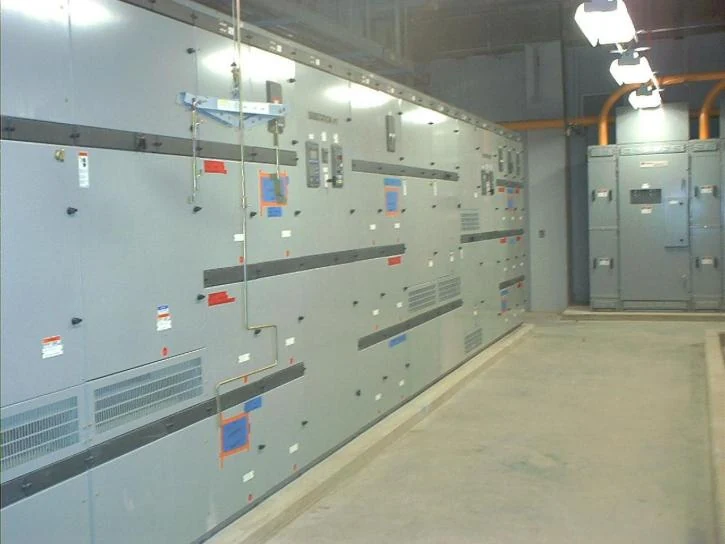
GE's Power/Vac application guide describes medium-voltage vacuum metalclad switchgear, distinct from the low-voltage AKD associations above. The guide shows modular arrangements with upper and lower compartments accommodating breakers and auxiliary devices, including two-high breaker stacking. When your records identify Power/Vac, describe the section arrangement rather than supplying only the total number of cabinet doors. [3]
The guide distinguishes indoor equipment from outdoor weatherproof equipment without an aisle, protected-aisle outdoor gear and common-aisle outdoor gear. A common aisle serves two facing lineups. State the form shown in your drawings and whether the enclosure or aisle structure is included. Do not infer metalclad classification from an enclosed appearance alone, or assume every visible compartment originally contained a breaker. [3]
06
Match ratings and drawings to the equipment offered
Transcribe the assembly voltage and bus-current ratings from existing labels or matching documents. List breaker ratings separately and preserve their units and wording. A bus withstand rating is not automatically a breaker interrupting rating. If a number is only visible on a breaker record, identify it as component information rather than applying it to the entire lineup.
Provide the one-line diagram, front elevation and section schedule if available. Explain which main, tie and feeder positions belong to the sale and which are excluded. For a lineup already divided into shipping sections, match each section identifier to the drawings. Where later revisions exist, include their dates and identify which version reflects the equipment offered; do not silently combine conflicting drawings.
07
Describe condition without claiming undocumented performance
State whether the gear is unused, previously operated, retired or of unknown service history. Give the known retirement date, storage conditions and any documented exposure, damage or missing components. Existing maintenance reports and modification records can clarify what changed, but an old report does not prove present operating condition. Avoid describing equipment as tested unless you can supply the applicable report and date.
Use exterior photographs already available or obtainable without electrical access and within site safety rules. Do not remove covers, access energized compartments, rack breakers or perform tests for this inquiry. Equipment described as switched off is not proof of safe electrical condition. Qualified personnel must handle inspection requiring access, electrical isolation and removal under appropriate procedures. [4]
08
Send a GE purchasing inquiry with the identity evidence
Text existing photographs to (951) 733-6603 or email electricalsurplusbuyers@gmail.com. Identify yourself as the owner or authorized seller and include the equipment location. Describe the GE assembly designation if known, section count, documented ratings, included breakers and auxiliary equipment, condition and availability. Attach matching drawings or explain which records are missing.
Mention any installed status or removal schedule so the inquiry does not assume the equipment is already disconnected and ready to move. Nationwide opportunities are reviewed case by case. Purchase scope, inspection requirements and transaction terms must be agreed for the particular assembly; sending an inquiry does not establish an offer, pickup arrangement or removal responsibility.